The Gold Junior That Could Make 2026: Why Formation Metals $FOMTF Is Trading Like Gold Never Hit $5,300
Most retail investors are making a critical mistake right now.
They're watching gold smash through $5,300 celebrating the metal's historic rally while the majors like Newmont and Barrick double off their lows completely missing where the real wealth gets created in gold bull markets. The junior explorers with actual discoveries don't move with gold. They lag for months, trading like the bull market doesn't exist, until suddenly they don't.
But here's what the smart money knows: we're at that exact inflection point right now. The majors have run. Newmont up 130% from 2024 lows. Barrick up 180% since early 2025. They've had their move. What comes next is the systematic re-rating of junior explorers with real assets in tier-one jurisdictions, and Formation Metals $FOMTF appears positioned at the center of this rotation.
Where are sophisticated resource investors seeing value that retail misses? Formation Metals currently trades at valuations severely disconnected from the $5,300 gold environment. The company has 30,000 meters of fully-funded drilling underway at a project with 870,000 ounces of historical gold resources in Quebec's legendary Abitibi Belt. They're hitting visible gold in multiple drill holes. They just reported 200+ meter mineralized intercepts. Yet the market prices $FOMTF like none of this matters.
In our view, this creates one of the most asymmetric opportunities available today. The disconnect between Formation Metals's current valuation and where Quebec gold explorers typically trade in bull markets of this magnitude is staggering. Every major gold cycle over the past 50 years has followed this exact pattern, and understanding that pattern provides critical context for what's unfolding now.
The Historical Pattern That Matters
In every major gold bull market, the sequence is identical. Gold rallies first. Then the major producers move as investors recognize operational leverage. Finally, once the majors are fully valued, capital floods into junior explorers searching for the next level of returns.
The 2001-2011 cycle tells the story perfectly. Gold went up 8x. Senior producers delivered average returns of 289.5%. But the TSX Venture Composite Index tracking primarily junior miners surged 440% from December 2001 to November 2007, then delivered another 376% from the 2008 crisis lows to March 2011. Individual companies with quality discoveries generated far more substantial returns. During the 1982-1983 Hemlo discovery cycle in Ontario, junior gold stocks with direct exposure averaged 4,000% returns in approximately 12 months. In the late 1970s bull market, 10x, 20x, and documented 100x+ returns were routine as discoveries advanced toward production or acquisition.
The mathematics are straightforward. Senior gold miners outperform gold by 2-3x during bull markets due to operational leverage. Junior explorers with substantive assets outperform gold by 5-10x or more because they combine discovery optionality with acquisition potential once resources are defined. Think about that for a moment.
We're at that inflection point now. Gold has delivered 194% returns from its late-2023 lows at $1,800. Newmont, Barrick, and Agnico Eagle have experienced their initial valuation expansions. But the junior sector? The TSX Venture Composite trades below its 2008 financial crisis lows.
Formation Metals $FOMTF exemplifies this disconnect perfectly: drilling what could become a multi-million-ounce gold system in one of North America's premier mining belts, yet trading at valuations that ignore the $5,300 gold environment entirely.
The market dynamics are exceptional. Major producers are generating record free cash flows Newmont reported $1.6 billion quarterly in Q3 2025, Barrick's net earnings jumped 69% in fiscal 2025 while sitting on massive cash piles with depleting reserve bases. Yet the 32 largest gold miners spent only $1 billion on exploration in H1 2025 compared to $5.6 billion returned to shareholders. That's 5.6:1, favouring buybacks over exploration.
The setup is clear: majors need reserves, they have the capital to acquire them, and there are fewer quality discoveries available than at any point in the past two decades. Newmont and Barrick are both actively evaluating junior targets to replenish reserves. Formation Metals, advancing toward a maiden NI 43-101 compliant resource estimate at a project with significant historical resources in Quebec, positions directly into this M&A cycle.
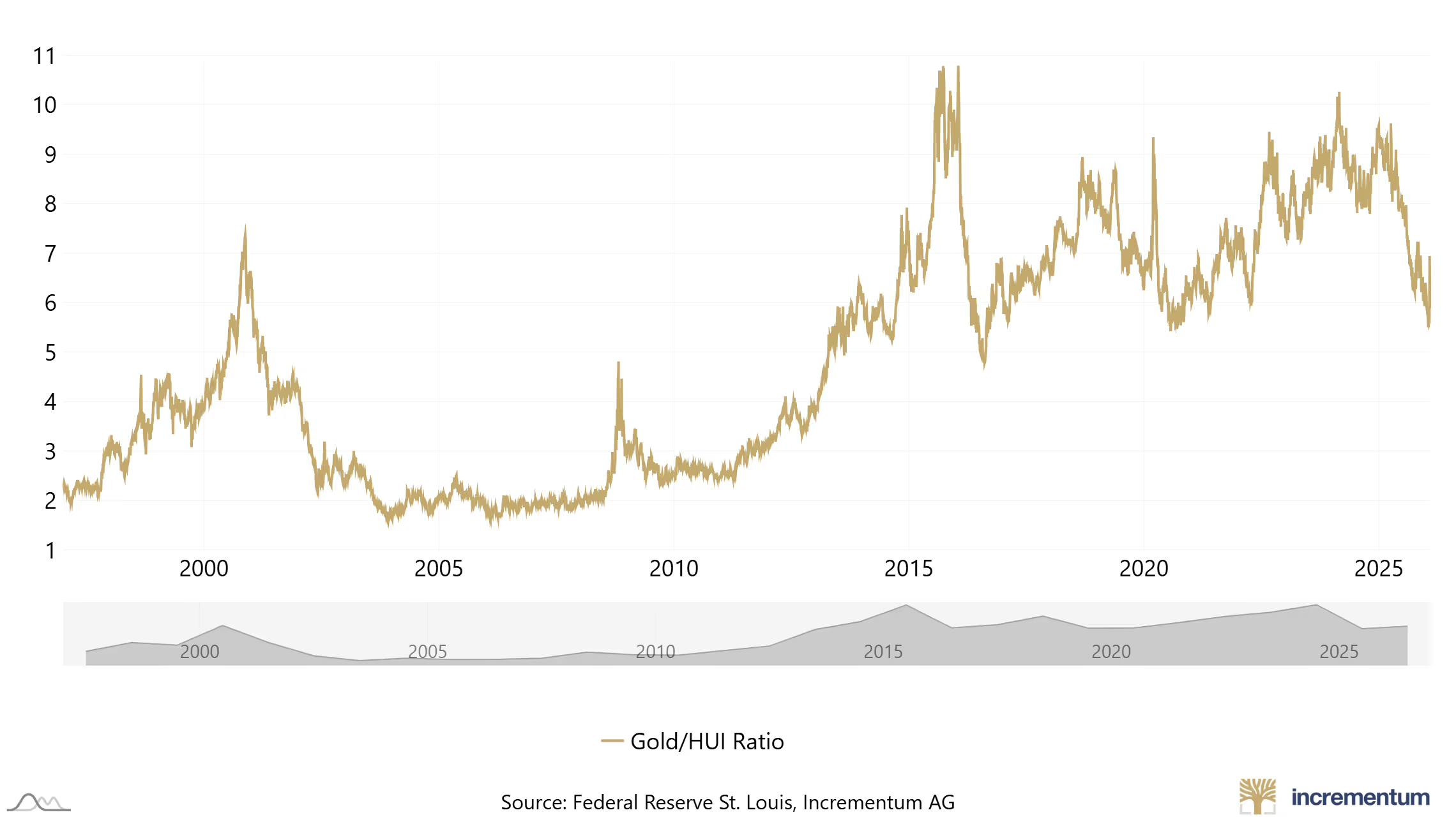
Image Source: "In Gold We Trust" annual report. Shows the ratio with recession overlays. Sourced from the Federal Reserve St. Louis data. https://ingoldwetrust.report/chart-gold-hui-ratio/?lang=en
Gold's Bull Market Has Structural Support
Central banks globally accumulated 863 tonnes of gold in 2025 despite prices already above $4,000 per ounce. Poland added 102 tonnes. Turkey purchased 27 tonnes. China continued its 14-month consecutive buying streak. When sovereign institutions with trillion-dollar balance sheets keep buying gold at record prices, they're making strategic allocation decisions driven by forces beyond short-term movements.
The performance data is remarkable. Gold has substantially outperformed technology stocks over the past two years. While the Nasdaq remains essentially flat from 2021 highs, gold has nearly tripled. Most "Magnificent Seven" tech stocks trade down or sideways from peaks. Gold became the best-performing major asset class of the decade while market attention remained focused elsewhere. Governments worldwide are running record deficits, printing currency at unprecedented rates, and increasingly weaponizing their financial systems. Gold is reasserting its 5,000-year role as the ultimate store of value, and retail participation is accelerating now which historically marks the beginning of the most explosive phase for junior explorers like Formation Metals $FOMTF
What Makes Formation Metals $FOMTF Different
Formation Metals separates from the vast majority of gold juniors through substance. The company has actual resources, a premier jurisdiction, visible evidence of significant mineralization, and financial strength that's almost unprecedented in the junior space.
The N2 Gold Project sits in Quebec's Abitibi Greenstone Belt, arguably the most prolific gold-producing region on Earth. Over the past century, this belt has yielded more than 200 million ounces of gold and hosts world-class deposits including Canadian Malartic, Detour Lake, and LaRonde. When you drill in the Abitibi, you're operating in a proven, tier-one jurisdiction where billion-dollar deposits have been discovered repeatedly and where major mining companies actively seek acquisitions.
Formation Metals brings a critical advantage: validating and expanding known mineralization rather than exploring blind. The N2 Project has a historical resource foundation of approximately 870,000 ounces of gold based on decades of prior exploration. This includes the A Zone (historically ~523,000 ounces averaging 1.52 g/t gold across 10.7 million tonnes) and the high-grade RJ Zone (~61,000 ounces at 7.82 g/t gold). These historical estimates predate modern NI 43-101 standards. Formation Metals is now systematically working to validate, expand, and upgrade them to compliant status.
The current drill program is delivering results that validate the approach. Formation Metals has intersected visible gold in multiple drill holes across different zones gold particles literally visible to the naked eye in drill core. These intercepts are significant because they typically correlate with economic grades. When geologists observe visible gold across multiple zones in a systematic program, it provides strong evidence of a substantial mineralized system.
Recent results reinforce this. The company reported drilling intercepts exceeding 200 meters of continuous mineralization, including one interval of 208.8 meters starting from just 28.6 meters depth. These represent broad, near-surface zones characteristic of large-tonnage, open-pit deposits exactly what major mining companies target for acquisition because they offer the bulk tonnage economics that support large-scale operations.
The scale potential remains largely untested. The A Zone has over 3.1 kilometers of strike length where modern drilling hasn't been conducted. The high-grade RJ Zone has only 900 meters drilled out of 4.75+ kilometers of prospective strike. Formation Metals could be systematically proving up a district-scale gold system with resource potential substantially exceeding the 870,000-ounce foundation, but the market continues valuing the company as if resource potential remains speculative.
Formation Metals advances this with financial strength that distinguishes it from typical juniors. The company maintains approximately $13.5 million in working capital with zero debt. The 30,000-meter drill program is fully funded. Most significantly, Formation Metals already expanded the original Phase 1 program from 10,000 meters to 14,000 meters based on positive results and additional high-priority targets.This financial position provides the runway to drill aggressively and follow up on discoveries immediately without diluting shareholders at inopportune times.
The Catalysts Approaching
Formation Metals $FOMTF has multiple value-inflection points approaching that could trigger the systematic re-rating juniors experience when they transition from exploration stories to proven discoveries.
First, the ongoing 30,000-meter drill program continues delivering results. The company has already expanded the program based on positive outcomes, indicating responsive geology rather than exhausted targets. With drilling ongoing and assay results flowing consistently, each set of data has potential to materially enhance the project's profile. The program focuses on zones that demonstrated gold historically but remain largely untested along strike and at depth. When companies drill into known zones and consistently hit mineralization, it demonstrates geological continuity and scale potential both of which the market values highly.
Second, Formation Metals is advancing toward a maiden NI 43-101 compliant resource estimate. This represents the transformational catalyst. Currently, the market values Formation Metals based on cash and some speculative premium for exploration potential. Once a compliant resource is established, combining historical data with the new 30,000-meter program, investors gain ability to calculate clear enterprise value per ounce metrics using standard industry comparisons.
Here's what matters: Quebec gold developers with maiden resources of 1-2 million ounces typically trade at enterprise values of $50-100+ per ounce during bull markets. Formation Metals, with 870,000 historical ounces as foundation and 30,000 meters of drilling to expand and validate that resource, trades at a fraction of these metrics. When the maiden resource is filed, this valuation gap should narrow substantially.
The resource estimate also positions Formation Metals as a potential acquisition target. Major gold producers are sitting on record cash flows from $5,300 gold while facing depleting reserve bases. Tier-one jurisdictions like Quebec represent exactly where strategic acquirers focus attention. A compliant resource at N2 transforms Formation Metals from a drilling story into strategic acquisition territory.
Compare Formation Metals' current valuation to historical precedents. The catalyst sequence follows a predictable pattern: assay results confirm economic grades, the maiden resource gets filed, research analysts initiate coverage, institutional funds add the stock to their screens, and valuation re-rates to sector norms. By the time this sequence completes and Bloomberg terminals display Formation Metals prominently, the substantial valuation expansion has typically already occurred.
The Trump Administration Just Validated the Hidden Asset
In early February 2026, President Trump announced Project Vault: a $12 billion strategic critical minerals stockpile combining $1.67 billion in private capital with a $10 billion Export-Import Bank loan. General Motors, Boeing, GE Vernova, and Google signed on as participants. Days later, the administration hosted over 50 countries at its inaugural Critical Minerals Ministerial, launching FORGE, a preferential trading bloc to counter China's dominance. The US signed bilateral deals with the UK, EU, Japan, and Mexico, with Canada's USMCA framework already under review for critical minerals provisions. The message is unambiguous: securing allied mineral supply chains is now a national security priority backed by billions in capital.
Formation Metals $FOMTF sits directly in the path of this policy shift. While most investors focus exclusively on N2 Gold, the company's Nicobat Project (nickel-copper-cobalt) and Rio Titanium Project provide exposure to commodities experiencing structural supply deficits driven by AI infrastructure, defense spending, and electrification. The market continues valuing $FOMTF almost exclusively on gold potential, largely overlooking this critical minerals optionality.
The demand fundamentals are compelling. By 2030, AI data centers alone will consume approximately 512,000 tonnes of copper annually. A single hyperscale data center requires up to 50,000 tonnes of copper for electrical infrastructure, plus massive quantities of nickel and cobalt for backup power systems. BloombergNEF projects the copper supply shortfall could reach 6 million tonnes by 2035.
Nicobat hosts a historical resource of 5.3 million tonnes grading 0.25% nickel, 0.14% copper, and 0.03% cobalt in Ontario. The Rio Titanium Project sits adjacent to Rio Tinto's Lac Tio Mine, the world's largest hard-rock titanium deposit, offering jurisdictional security in Quebec while China controls over 90% of refined titanium production and continues weaponizing export restrictions. Formation Metals holds all the minerals Project Vault is targeting in Canadian jurisdictions that qualify as secure, allied sources.

Image Source: eenews.net - Vice President JD Vance speaks at the Critical Minerals Ministerial at the State Department on Wednesday in Washington. - Kevin Wolf/AP
Five Reasons Formation Metals $FOMTF Deserves Immediate Attention
1. The gold supercycle is accelerating
Gold at $5,300 with structural drivers (central bank buying, monetary debasement, geopolitical instability) showing no signs of reversing. The mining cycle follows its historical pattern: majors experience initial expansion, followed by systematic re-rating of juniors with substantive assets. We're at that inflection point now.
2. The valuation disconnect is staggering.
Formation Metals has 870,000 historical ounces, 30,000 meters of fully-funded drilling underway, visible gold discoveries, and 200+ meter mineralized intercepts in Quebec's Abitibi Belt home to 200+ million ounces of historical production and billion-dollar takeover deals. Quebec gold developers with similar resources trade at enterprise values of $50-100+ per ounce. $FOMTF trades at a fraction of that.
3. Multiple catalysts are converging.
The ongoing drill program delivers results continuously. The maiden NI 43-101 resource estimate approaches. Once filed, investors can compare $FOMTF directly to peers using standard metrics. The valuation disconnect should narrow substantially. Major mining companies with record cash flows are actively hunting acquisitions in tier-one jurisdictions. A compliant resource at N2 puts Formation Metals squarely in acquisition territory.
4. The diversified critical minerals portfolio positions them at the forefront of US Policy
Formation Metals maintains $13.5 million in cash with zero debt and no near-term dilution risk. The company already expanded its drill program from 10,000 to 14,000 meters based on positive results. Most juniors are scrambling for financing every six months. Formation Metals has the runway to complete its entire program and deliver a maiden resource without touching capital markets.
5. The diversified critical minerals portfolio positions them at the forefront of US Policy
While the market values FOMTF almost exclusively on N2 gold, the company holds Nicobat (nickel-copper-cobalt) and Rio (titanium) direct exposure to commodities experiencing structural supply deficits with explicit US government commitment to secure supply through the $12 billion Project Vault stockpile. If Formation Metals advances even preliminary work on either project, the market would need to comprehensively reassess the value proposition.
In our view, these five factors create a compelling case. The smart money recognizes patterns in gold cycles. Catalysts are approaching. The valuation disconnect won't last forever.
The Opportunity Is Clear
Here's what makes this opportunity so compelling. Formation Metals $FOMTF is drilling what could become a multi-million-ounce gold system in Quebec's premier mining belt during the biggest gold bull market in history. The company has the assets, the jurisdiction, the financial strength, and the catalysts approaching. Yet the market continues pricing FOMTF as if the $5,300 gold environment doesn't exist.
Insiders and strategic investors hold approximately 67% of the company, reflecting conviction in the long-term value proposition. Their positioning indicates a multi-year outlook as Formation Metals transitions from explorer to developer.
But here's what we find most compelling about $FOMTF: acquire the company today for gold exposure and proven N2 resource potential, receive diversified exposure to the biggest US policy mega trend right now - critical minerals to fuel the AI and defence revolution. As data center construction accelerates and mineral shortages intensify, the optionality value of Nicobat and Rio is what sets $FOMTF as a clear standout in the market of Junior exploration stocks.
We rarely see opportunities where geological validation, jurisdictional quality, financial strength, and multiple commodity exposures converge so perfectly. The drill program is ongoing. The assays are pending. The resource estimate is approaching. We believe investors who understand what's happening here should put Formation Metals $FOMTF on their radar immediately, before this quiet accumulation story becomes tomorrow's headline breakthrough. The gold supercycle draws attention today. The AI minerals boom, now explicitly backed by $12 billion in US government capital, provides the long-term structural support that could make this a decade-defining investment.