The Quiet Hedge to the AI Bubble That Wall Street Isn’t Talking About
The surge in AI-related stocks has created what many analysts are now calling an “AI bubble.” Stock prices for major AI companies have climbed far faster than their underlying revenues, and history shows that markets built on aggressive expectations eventually correct.
But the long-term technology trend behind AI is real, investors looking for a more stable way to participate are starting to focus on the one part of the AI ecosystem that isn’t inflated: the minerals that are powering it.
AI isn’t just software. Every model, every data center, and every chip requires large amounts of copper, nickel, cobalt, zinc, and rare earth elements. Without these materials, the entire AI build-out is impossible. While tech stocks can swing wildly on headlines… mineral demand is tied to physical supply, global infrastructure, and the time it takes to discover and develop new deposits. This makes it one of the few areas where investors can gain long-term exposure to AI without paying bubble-level prices.
That is why we are seeing battery and technology metals gaining such strong attention. They aren’t a side theme or a speculative bet. They are the real infrastructure behind modern computing. Companies holding high-quality mineral assets are positioned to benefit from long-term demand, even if the AI software bubble eventually bursts.
Glenstar Minerals Inc. (OTC: GSTRF) sits directly in this foundation layer of the AI economy. The company is developing strategic raw-material projects that support data center expansion, chip production, and electrification. By securing and advancing geological assets, Glenstar offers exposure to the essential inputs behind the AI megatrend. But more on them later.
The Four-Stage AI Value Chain: Why Minerals Form the Foundation
The current AI landscape is often viewed as a four-tier system:
Tier 4 – Applications:
AI apps and platforms for end users. They scale fast, attract fast funding, and face high risk of overvaluation. (Think ChatGPT or Cursor)
Tier 3 – Foundation model developers:
Groups with intensive capital needs and large valuations, competing to improve model performance and control data. (Think OpenAi or Anthropic)
Tier 2 – Semiconductors and hardware:
Firms that supply computing power, including chip designers, manufacturers, and makers of specialized equipment. (Think Nvidia or ASML)
Tier 1 – Energy and mineral inputs:
The base of the entire system. Without this layer, computing power and data processing do not exist. (Think mineral producers)
While the higher tiers receive most of the attention, the most stable value creation sits at the bottom. Speculative capital flows into Tier 3 and Tier 4 as trends shift. Tier 1 grows due to real limits in energy and materials, not hype.
The early internet showed the same pattern. Startups rose and fell, while the physical systems behind the network became the long-term winners. In today’s AI cycle, the physical inputs come from companies that control essential minerals.
This is the area where Glenstar Minerals Inc. (OTC: GSTRF) is building its position. Not in software, but in the foundational layer that enables scale.
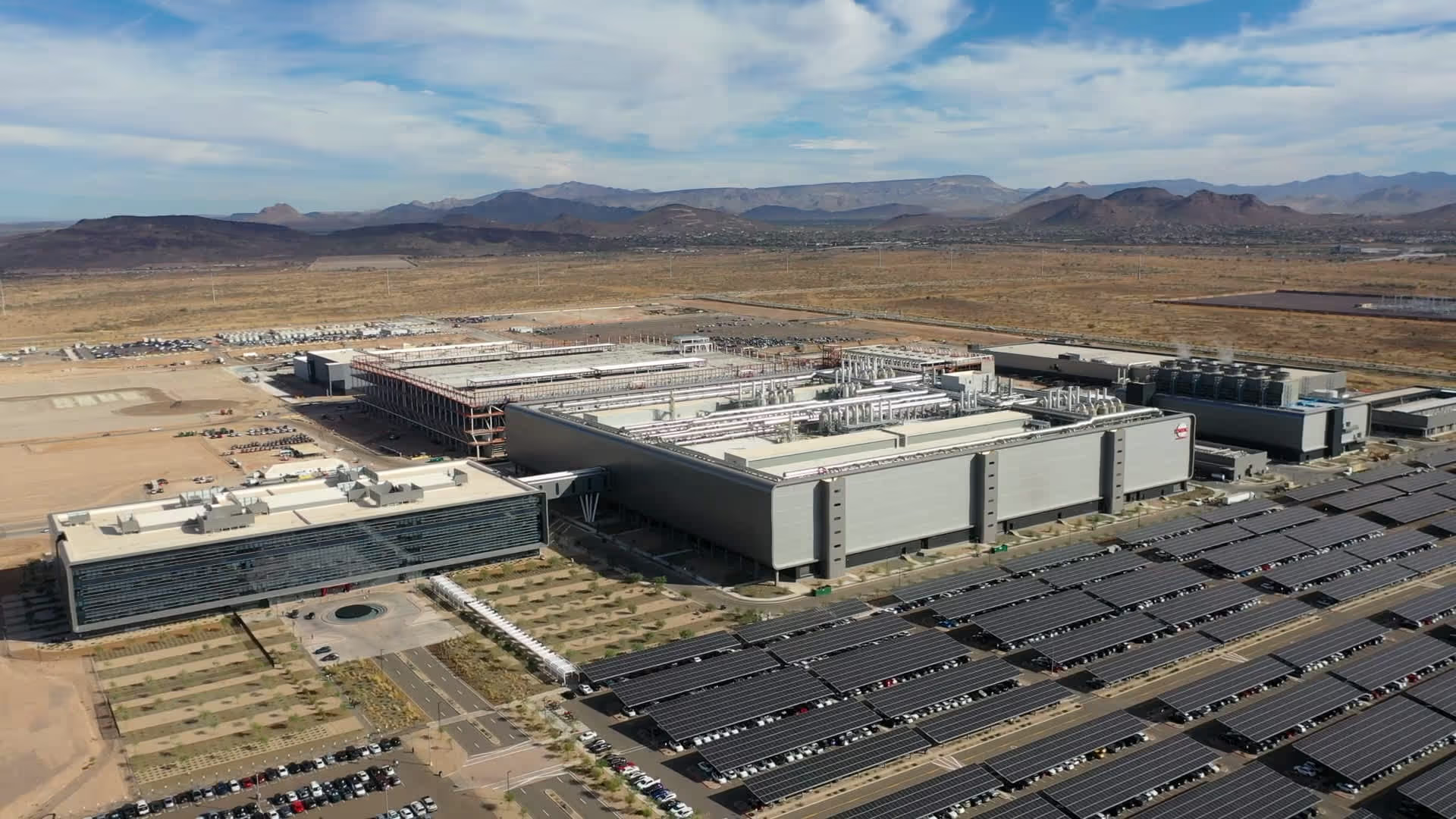
Image: TSMC’s $165 billion semiconductor complex in Arizona, making advanced chips on U.S. soil for the first time. https://www.nbcsandiego.com/news/business/money-report/tsmc-says-first-advanced-u-s-chip-fab-dang-near-back-on-schedule-heres-an-inside-look/3700206/
Why Urgency is Now Rising
Two major forces are colliding at the same time:
America’s tech sector: Hundreds of billions of dollars are being committed to build AI infrastructure, creating material demand at record levels.
China’s export controls: China continues to tighten restrictions on strategic minerals, increasing pressure on global supply chains.
The US response is clear and in motion. Building domestic reserves, government support for domestic mining, and strengthen supply chains across America.
In this setting, Glenstar Minerals Inc. (OTC: GSTRF) sits at the intersection of the AI bubbles safety play, supply pressure, national policy, and the AI buildout. Its projects in Nevada are located near TSMC’s planned 165 billion USD chip facilities and close to major developments like Tract’s 100 billion USD data center zone and Vantage’s 3 billion USD hyperscale site. Glenstar gives investors access to a region that is becoming central to America’s resource strategy for AI, defense, and energy systems.
Market Failures and Bottlenecks in Minerals Supply
The market for critical minerals faces structural challenges that reach beyond short supply. Exploration is not growing at the pace required by the technology and energy sectors. Exploration timelines across the sector have slowed due to permitting bottlenecks, intensified by the recent nationwide government shutdown.
The company stands out becasue they have already secured full drilling permits for its flagship Green Monster Project, giving it a clear operational advantage while many peers remain stuck in regulatory queues.
Geopolitical risk adds to the strain. Many critical minerals come from regions with unstable politics or unreliable supply lines. This creates dependence that is difficult to manage.
Investors often avoid early mineral projects due to exploration risk, resource uncertainty, and commodity price swings. Capital flowing into technology focuses on software and data centers, not raw materials.
This creates a gap in the value chain.
Companies like Glenstar Minerals Inc. (OTC: GSTRF) fit into this gap by targeting strong geology in secure regions, applying modern tools, and developing projects with a clear plan. In a world where critical minerals support AI infrastructure, their importance rises for both investors and national policy.
Glenstar Minerals: Company Profile
Business model and listings:
Glenstar Minerals Inc. (OTC: GSTRF) is focused on polymetallic exploration with emphasis on critical metals. The company aims to advance new deposits through sustainable fieldwork, targeted acquisitions, and structured geological programs.
Glenstar trades on the OTCQB as GSTRF, on the CSE as GSTR, and on the Frankfurt Stock Exchange as VO20.
Strategic focus:
Glenstar positions itself as a future supplier for technology and energy markets. Its projects are in Nevada, a stable and exploration-friendly region with strong infrastructure.
The company focuses on battery metals and critical minerals such as nickel, cobalt, copper, zinc, and uranium. These inputs are essential for batteries, semiconductors, and data-heavy technology. Glenstar highlights this priority across its communications.
The Green Monster project has it’s drilling permits in place, and the company has secured a specialist contractor. Recent capital raises provide funding to advance exploration programs.
With strong geology, a clear focus on critical metals, and disciplined capital management, Glenstar Minerals Inc. (OTC: GSTRF) is positioning itself as a steady supplier in a market shaped by structural change.
The AI-driven Raw Materials Cycle: Glenstar’s Positioning
AI is exposing a core vulnerability for the United States. The country does not produce enough of the minerals required for these systems. Bloomberg estimates that AI infrastructure expansion will require an additional 400,000 tons of copper per year.
US tech leaders expect AI infrastructure spending to reach about 364 billion USD in 2025. Every dollar relies on minerals that the US produces in limited volume.
Glenstar Minerals Inc. (OTC: GSTRF) is positioned to benefit from this shift. With the Green Monster project located near Arizona’s semiconductor corridor, where TSMC plans six advanced factories worth 165 billion USD, Glenstar sits close to the core of America’s new technology base.
Nevada provides strong infrastructure, access to energy, transportation, and skilled labor. Drilling has confirmed mineralized zones. At the same time, the region is attracting large investments from data center developers and technology firms.
This positioning signals what the broader market may begin to recognize. As AI infrastructure expands, investor focus is shifting from software toward the physical inputs behind the system.
Glenstar Minerals Project Portfolio
Wildhorse Project (Nevada)
Located in northwestern Nevada, this area hosts polymetallic deposits with nickel, copper, cobalt, and rare earth elements. Glenstar aims to define a long-term resource for battery and AI-related technologies through fieldwork, sampling, and geophysical mapping. The region supports exploration with strong infrastructure and secure jurisdiction.
Green Monster Project (Nevada)
This project is near established mines and hosts recorded polymetallic deposits including copper, nickel, cobalt, and zinc. A drilling program has been approved, and modern tools are being used to refine the structural model.
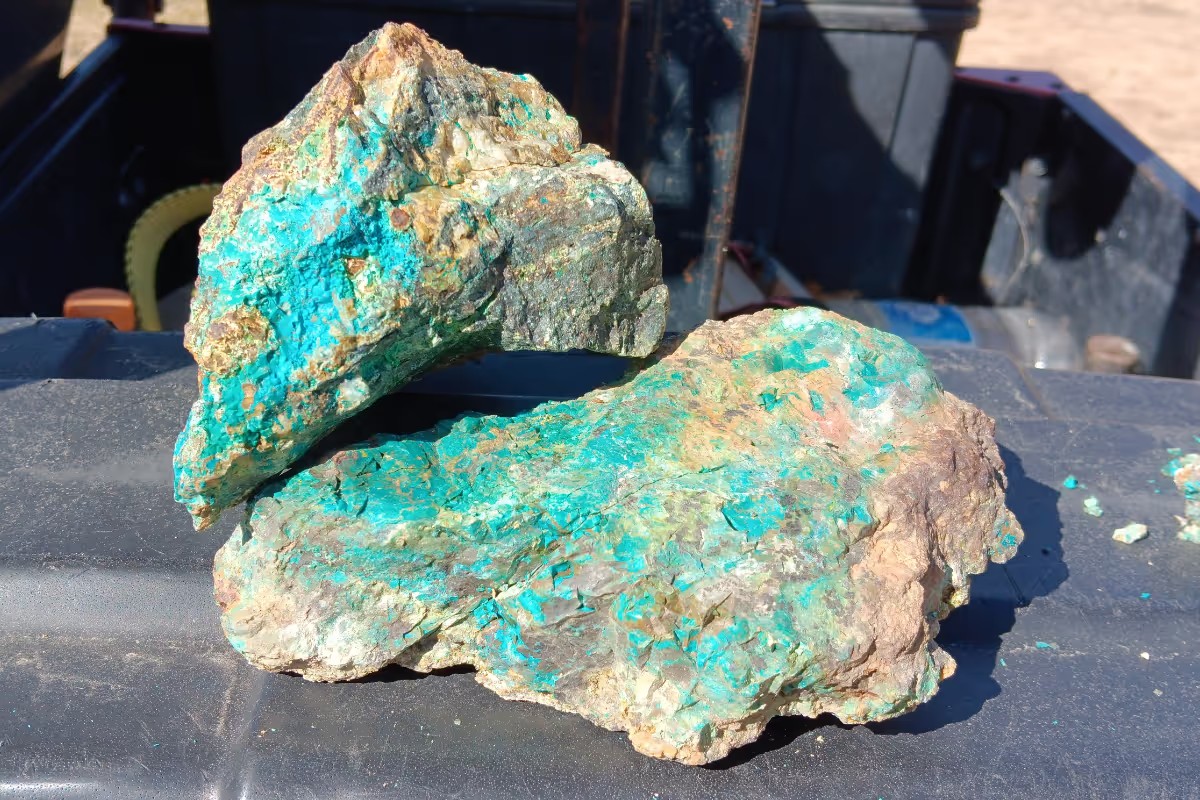
Image: Glenstar Minerals results of first round sampling. https://glenstar.ca/about-us/#history
Glenstar in the AI Super-cycle
AI is creating sustained demand for critical minerals. Data centers, chip production, electrification, and energy storage all rely on copper, nickel, cobalt, zinc, and rare earth elements.
In this environment, Glenstar Minerals Inc. (OTC: GSTRF) holds a strategic position. Nevada provides political stability, strong infrastructure, and predictable permitting. The region hosts deposits with high industrial value.
By advancing its projects, Glenstar aligns itself with the core inputs of the AI supercycle. These metals cannot be replaced and remain essential for computing and electrification.
Management and Technical Expertise
David K. Ryan – President, CEO and Director
Provides long-term experience in corporate leadership and capital market strategy. Under his guidance, Glenstar is focused on battery metals and strategic minerals in North America.
Rob Marvin – Geology Consultant
Robert Marvin is a Qualified Person under NI 43-101 and has worked as a geologist since the 1970s. He brings extensive global experience in exploring and evaluating gold, copper, zinc, lithium, and uranium projects. He played a key role in a multi-billion-ton lithium discovery and led successful exploration programs that resulted in acquisitions.
Logan Bruce Anderson – CFO, Secretary and Director
Leads financial strategy, governance, and capital structure with strong experience in financial management.
Together, the team combines technical skill with market understanding, allowing Glenstar to advance exploration programs and form strategic relationships.
Conclusion: The Investment Thesis
Software and model developers will always capture headlines, often pulling investors deeper into valuation bubbles. Hardware companies surge on demand as well, but remain vulnerable to rapid sentiment shifts. The most durable part of the AI value chain may ultimately be the supply of minerals that make the entire system possible.
That is why minerals are becoming a focal point for long-term positioning. They don’t respond to hype cycles; they move according to physical scarcity, infrastructure spending, and national policy. Today, all three forces are accelerating at the same time.
America’s push to onshore supply, China’s tightening export controls, record AI infrastructure budgets, and the widening gap between mineral demand and new discoveries all point toward the same pressure point in the value chain.
This is the landscape in which Glenstar Minerals Inc. (OTC: GSTRF) is positioning itself. With projects in a secure U.S. jurisdiction, located near one of the most important emerging chip and data-center corridors in the country, and with drill permits already in place, the company aligns with the core themes shaping the next phase of the AI economy: supply-chain security, resource independence, and the race to deliver the materials required for scale.
As AI continues to expand, markets will eventually adjust to the mismatch between rising demand for critical minerals and the slower pace of new supply. Investors who recognize this structural imbalance early, and understand that the most stable AI exposure begins at the bottom of the value chain, could be positioned to benefit before broader capital rotates in.
Sources:
(1) https://www.worldbank.org/en/research/commodity-markets
(2) https://www.reuters.com/world/us/us-defense-department-buy-cobalt-up-500-million-2025-08-21/
(3) https://www.doi.gov/pressreleases/department-interior-releases-draft-2025-list-critical-minerals
(4) https://www.fraserinstitute.org/studies/annual-survey-mining-companies-2024
(3) https://www.mckinsey.com/industries/metals-and-mining/our-insights/the-future-of-nickel-a-class-act
(4) https://www.cnbc.com/2025/07/08/trump-tariffs-copper-trade.html
(5) https://www.iea.org/reports/global-supply-chains-of-ev-batteries
(6) https://www.congress.gov/bill/117th-congress/house-bill/5376/text
(9) https://www.fraserinstitute.org/studies/annual-survey-of-mining-companies-2023
(10) https://pubs.usgs.gov/fs/2014/3035/pdf/fs2014-3035.pdf
(12) https://www.usgs.gov/centers/nmic/antimony-statistics-and-information
(13) https://www.usgs.gov/centers/nmic/tungsten-statistics-and-information
(14) https://www.iea.org/reports/the-role-of-critical-minerals-in-clean-energy-transitions
(15) https://www.usgs.gov/faqs/what-a-critical-mineral
(18) https://glenstar.ca/investors/
(20) https://www.iea.org/reports/the-role-of-critical-minerals-in-clean-energy-transitions
(21) https://www.usgs.gov/centers/national-minerals-information-center/mineral-industry-nevada
(22) https://www.jpmorgan.com/insights/global-research/commodities/copper-outlook
(News Headline 1) https://www.cnbc.com/2025/11/21/google-must-double-ai-serving-capacity-every-6-months-to-meet-demand.html
(News Headline 2) https://openai.com/index/five-new-stargate-sites/
(News Headline 3) https://www.mining.com/web/us-in-talks-to-set-up-5-billion-fund-for-critical-mineral-deals/