The AI Picks and Shovels Play Wall Street Hasn't Priced In
Most investors chasing the AI boom are making a critical mistake right now.
They're piling into NVDA, GOOGL, MSFT, the same overpriced tech darlings everyone's talking about, while completely missing where real money gets made. AI doesn't run on code alone. It runs on physical materials. Copper, Nickel, Cobalt, and Titanium are essential.
And on February 2nd, 2026, the Trump administration just validated exactly what smart money has known for months: these materials are strategic national priorities worth $12 billion in government capital.
But here's what institutional resource investors know: while tech stocks trade at nosebleed valuations, junior mining companies with actual critical minerals assets in tier-one jurisdictions trade like the AI boom doesn't exist.
Formation Metals $FOMTF currently holds a North American critical minerals portfolio of nickel, copper, cobalt, and titanium, positioned directly in the path of unprecedented demand, yet trades at valuations that ignore the structural supply crisis entirely.
In our view, this creates one of the most asymmetric opportunities available today. The Trump administration's announcement this morning of Project Vault, a $12 billion strategic stockpile targeting the exact minerals Formation Metals $FOMTF holds, represents the kind of government validation that typically precedes major sector re-ratings. The disconnect between Formation Metals' current price and where North American critical minerals developers trade during supply crises of this magnitude is staggering.
Trump's $12 Billion Validation
On February 2, 2026, Bloomberg broke the story: President Trump is launching Project Vault, a strategic critical minerals stockpile with $12 billion in seed money. The initiative combines $1.67 billion in private capital with a $10 billion Export-Import Bank loan to procure and store minerals for automakers, technology companies, and manufacturers.
General Motors, Stellantis, Boeing, Corning, GE Vernova, and Google have already signed on as participants. The stockpile will focus on minerals including gallium, cobalt, nickel, copper, and titanium, materials used in products from iPhones and batteries to jet engines and AI infrastructure.
This represents Washington's explicit recognition that critical mineral supply chains have become national security priorities. The message to investors is unambiguous: the US government is willing to deploy billions in capital to secure domestic and allied sources of these materials. Formation Metals $FOMTF holds nickel, copper, cobalt, and titanium projects in Canadian jurisdictions that qualify as secure, allied sources under US strategic frameworks.
The timing matters. US rare-earths stocks jumped in premarket trading on the announcement. The administration has taken the unusual step of investing directly in domestic mining companies to boost US production. Last month, a bipartisan group introduced legislation for an additional $2.5 billion mineral stockpile. The One Big Beautiful Bill Act allocates $7.5 billion for critical minerals, including $2 billion to expand the national stockpile by 2027.
When the US government announces it will spend $12 billion stockpiling the exact minerals in your portfolio, the strategic value proposition changes overnight. Formation Metals $FOMTF holds all the minerals Project Vault is targeting, in mining-friendly Canadian jurisdictions with established infrastructure, skilled labor, and stable governance. The market hasn't priced this in yet.
On February 4th, 2026, the Trump administration hosted its inaugural Critical Minerals Ministerial, bringing together over 50 countries to launch FORGE, a new preferential trading bloc for critical minerals designed to counter China's dominance. The UK signed a Memorandum of Understanding with the US that same day, with frameworks also announced alongside Mexico, the EU, and Japan, signaling an unprecedented expansion of allied mineral partnerships.
The US aggressively locking down critical minerals deals with allies across the globe sends a clear signal: Washington is building a coalition of secure mineral suppliers, and Canada is uniquely positioned to benefit. With its shared border, existing USMCA trade framework now under review with explicit critical minerals provisions, and some of the most mining-friendly jurisdictions in the world, Canadian-based developers like Formation Metals $FOMTF represent the closest-proximity supply solution available for the US strategic reserve.
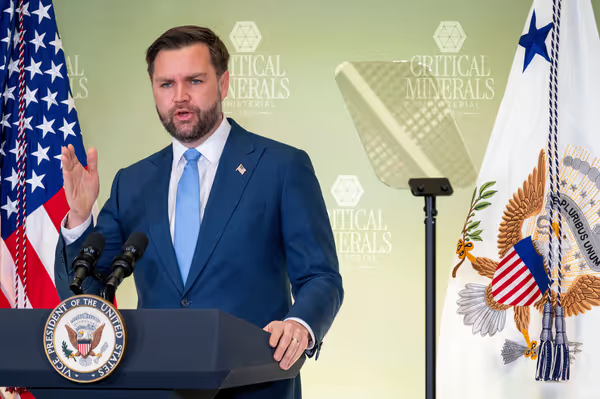
Image Source: eenews.net - Vice President JD Vance speaks at the Critical Minerals Ministerial at the State Department on Wednesday in Washington. - Kevin Wolf/AP
The AI Infrastructure Boom Requires Physical Materials at Unprecedented Scale
Everyone's excited about AI. But here's what most investors miss: AI infrastructure requires massive amounts of physical materials that the mining industry is completely unprepared to supply.
By 2030, AI data centers alone will consume approximately 512,000 tonnes of copper annually, representing 2-3% of total global demand according to the International Energy Agency. A single hyperscale AI data center requires up to 50,000 tonnes of copper for electrical infrastructure, cooling systems, and backup power. Microsoft's 80-megawatt Chicago data center consumed 2,100 tonnes of copper during construction. With AI data centers expected to represent over 60% of new facilities by 2035, mineral intensity is accelerating dramatically.
AI data centers require massive quantities of nickel, cobalt, and copper for uninterruptible power supply systems. When you're running thousands of GPUs processing billions of dollars in compute, you can't afford power outages. A single Nvidia H100 GPU draws over 700 watts; data centers operating 100,000 GPUs generate gigawatts of compute while requiring enormous mineral quantities for cooling operations, backup batteries, and thermal management.
BloombergNEF projects the copper supply shortfall could reach 6 million tonnes by 2035, with AI data centers pushing demand into territory the mining industry remains unprepared to meet. The World Economic Forum estimates each megawatt of data center capacity embeds 60-75 tonnes of minerals, primarily in power and cooling systems. The capital expenditure for global data center power infrastructure could reach trillions by 2030, with critical minerals accounting for significant portions.
This is where Formation Metals $FOMTF positions directly into the demand wave. The company's Nicobat Project in Ontario and Rio Titanium Project in Quebec provide exposure to the exact battery metals and strategic minerals experiencing structural supply deficits driven by AI infrastructure buildout.
Formation Metals: The Nicobat Battery Metals Asset
Formation Metals' 100%-owned Nicobat Project in Ontario hosts a historical resource of 5.3 million tonnes grading 0.25% nickel, 0.14% copper, and 0.03% cobalt. These are precisely the battery metals required for data center backup systems. Nickel, cobalt, and copper form the essential battery chemistry for uninterruptible power supplies that maintain AI infrastructure operation during outages.
The project sits in Dobie Township, Northwest Ontario, approximately 21 kilometers south of New Gold's Rainy River Mine which hosts the Zone 34 nickel discovery. Historic exploration work between 1952 and 1972 included over 15,000 meters of drilling, 220 drill holes, and numerous bulk samples that identified the historical resource. The historical estimate contained a high-grade zone of approximately 225,000 tons grading 0.87% nickel.
Recent exploration work included over 4,000 meters of drilling that confirmed high-grade nickel-copper shoots exist and grade considerably better than previously recorded in historical drilling. Drill hole A-04-15 intersected from surface to approximately 63.75 meters a weighted average of 1.05% nickel and 2.18% copper, including an approximately 9.8-meter interval of 1.92% nickel from 53.95 to 63.75 meters.
The project benefits from year-round access via provincial roads, proximity to infrastructure and labor, and Ontario's mining-friendly regulatory framework. Nickel plays a major role in boosting energy density in lithium-ion batteries, particularly in NMC (nickel-manganese-cobalt) chemistries crucial for high-performance electronics and energy-intensive AI systems. Formation Metals holds the financial strength to advance Nicobat through additional drilling and metallurgical work without near-term dilution pressure. The Nicobat resource sits directly in the path of unprecedented AI-driven demand.
Formation Metals: The Rio Titanium Strategic Asset
Located directly adjacent to Rio Tinto's Lac Tio Mine (the world's largest hard-rock ilmenite titanium deposit), Formation Metals' Rio Project provides strategic exposure to a critical mineral designated essential for aerospace, defense, and advanced manufacturing. Titanium appears on the official US government 2025 List of Critical Minerals published by the USGS.
Here's what makes titanium different from every other critical mineral: it's not just about AI data centers or electric vehicles. Titanium is defense. Every F-35 Lightning II fighter jet, the cornerstone of NATO's air superiority strategy, uses titanium extensively throughout its airframe and engine components. Lockheed Martin delivered a record 191 F-35s in 2025, bringing the global fleet to approximately 1,300 aircraft. The F-22, F/A-18, C-17, and UH-60 Black Hawk helicopter all consume massive titanium quantities. The aerospace industry considers titanium availability a matter of national security.
Trump's defense buildup validates exactly why. The administration is pushing a record-breaking $1 trillion defense budget for fiscal 2026, a 12% increase from current levels. Trump demanded all NATO countries increase defense spending to 5% of GDP, up from 2%, with Poland and Lithuania already committed. The administration's One Big Beautiful Bill Act allocates $7.5 billion for critical minerals, including $2 billion to expand the national stockpile by 2027. This represents the most dramatic defense spending acceleration since the Cold War.
The geopolitical angle makes Rio even more compelling. China controls over 90% of refined titanium production. In late 2024-2025, China placed export restrictions on gallium, germanium, antimony, tungsten, tellurium, bismuth, indium, and molybdenum, demonstrating how critical mineral supply chains have become weaponized. As Trump pushes unprecedented NATO defense spending increases and accelerates US military production, secure non-Chinese titanium sources become essential infrastructure.
Formation Metals' Rio Project, adjacent to one of the world's few non-Chinese titanium sources, offers jurisdictional security in Quebec with stable governance and established infrastructure. Trump's Project Vault announced this morning specifically targets titanium to reduce Chinese dependence. Formation Metals $FOMTF holds the asset in a Canadian jurisdiction that qualifies as a secure, allied source exactly when the US government is deploying $12 billion to secure these supply chains.
The Supply-Demand Crisis Creating Asymmetric Opportunity
The supply-demand imbalance for critical minerals is severe and worsening. Nearly 60% of refined copper originates from just three countries. Over 90% of aluminum, titanium, silicon, and rare earths are sourced from three dominant producers, primarily China. This concentration creates vulnerabilities to supply shocks from trade restrictions, geopolitical tensions, or climate events.
The U.S. Geological Survey warns that geographic concentration of critical mineral production poses significant risks precisely when AI infrastructure demands are surging. The US imported 80% of the rare earth elements it consumed in 2024, leaving key industries exposed to export controls and geopolitical retaliation.
Formation Metals $FOMTF offers increasingly rare exposure: North American critical minerals in tier-one jurisdictions. Quebec and Ontario provide mining-friendly regulatory frameworks, established infrastructure, skilled labor forces, and stable governance. As AI companies and government agencies scramble to secure mineral supply chains outside Chinese control, projects like Nicobat and Rio become strategically valuable beyond their economic metrics alone.
The IEA predicts that by the 2040s, clean energy and AI combined could account for over 40% of copper and rare earth use, 60-70% of cobalt and nickel use. Formation Metals' portfolio maps directly onto these projections. But the market currently values Formation Metals almost exclusively on its N2 Gold Project, treating the critical minerals portfolio as essentially free optionality.
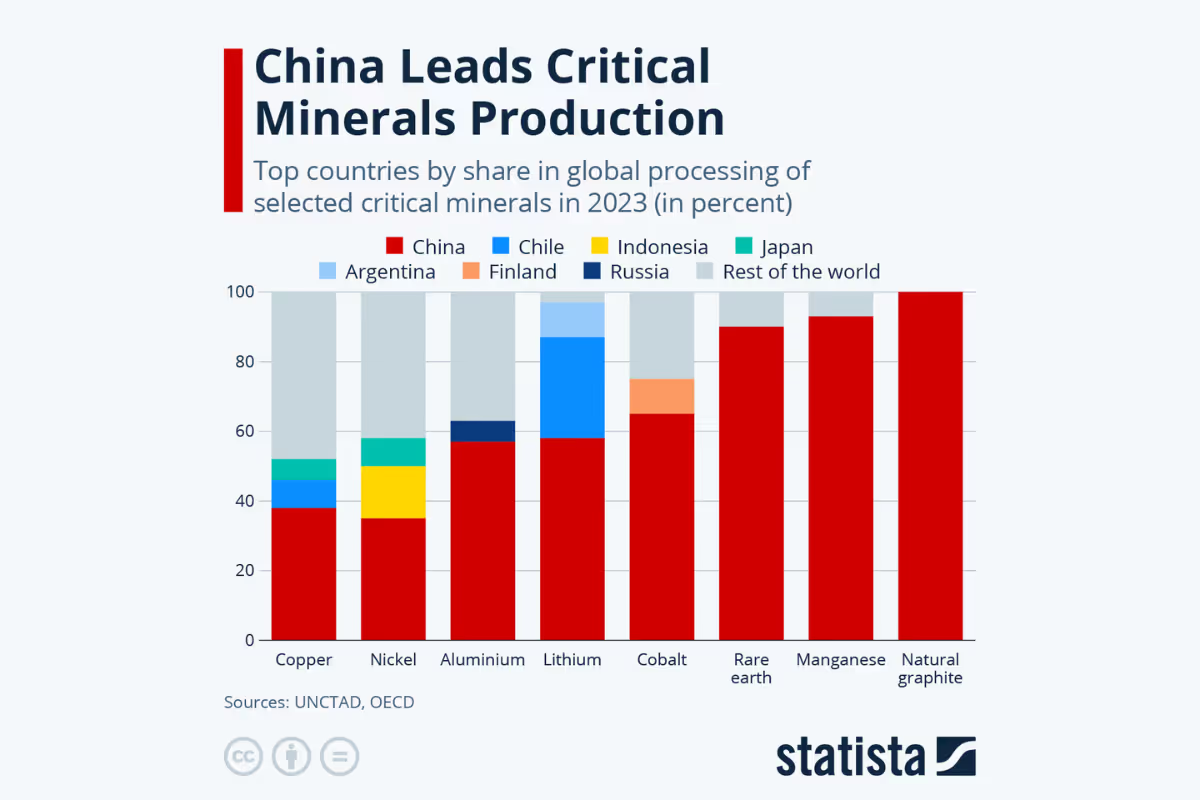
China dominates global processing of nearly every critical mineral, controlling up to 100% of natural graphite and over 90% of rare earths. (Source: UNCTAD, OECD via Statista)
Why Wall Street Hasn't Priced This In Yet
Formation Metals $FOMTF recently listed on major exchanges (CSE in October 2024, OTCQB more recently), expanding its investor base exactly as the critical minerals mega trend accelerates. The company has attracted institutional attention primarily through its N2 Gold Project in Quebec, where 30,000 meters of fully-funded drilling continues delivering visible gold intercepts and 200+ meter mineralized zones.
But this morning's Trump announcement changes the investment thesis entirely. When the US government commits $12 billion to stockpile nickel, copper, cobalt, and titanium, with Fortune 500 companies signing on as participants, Formation Metals' diversified portfolio suddenly positions the company at the center of multiple government-backed initiatives. The company holds all four minerals targeted by Project Vault in Canadian jurisdictions that qualify under the program.
The company maintains strong financial positioning with experienced management. CEO Deepak Varshney is a geologist with over 15 years of industry experience who has raised over $100M in the past 3 years. CFO Khalid Naeem brings 18 years of experience in finance and commodities. The board combines expertise from capital markets, exploration, and management. Insiders and strategic investors hold significant positions, reflecting conviction in the long-term value proposition.
Formation Metals trades on the CSE under symbol FOMO, on the OTCQB under FOMTF, and on the Frankfurt Exchange under VF1, providing accessibility across multiple markets. The recent OTCQB listing expands the US investor base exactly as AI infrastructure demand and government stockpiling programs are accelerating.
The Catalysts Converging
Formation Metals has multiple value-inflection points approaching that could trigger systematic re-rating as the market recognizes the company's critical minerals exposure.
First, ongoing work at the Nicobat Project. The company has completed a NI 43-101 compliant technical report documenting historical exploration and recent drilling results. Formation Metals can advance the project through additional drilling, metallurgical testing, and resource estimation work. Any positive developments at Nicobat gain amplified significance in the context of Project Vault and accelerating AI infrastructure buildout.
Second, strategic positioning at Rio Titanium. Located directly adjacent to Rio Tinto's world-class Lac Tio Mine, Formation Metals' Rio Project provides immediate proximity to proven titanium mineralization in a tier-one jurisdiction. Early-stage work including surface sampling, geological mapping, and geophysical surveys could demonstrate the project's titanium potential. Given titanium's critical mineral designation and Chinese export restrictions, even preliminary positive results could materially enhance Formation Metals' valuation.
Third, the N2 Gold Project continues advancing with 30,000 meters of fully-funded drilling underway, providing near-term newsflow while the market begins recognizing the critical minerals value proposition. Formation Metals $FOMTF benefits from dual exposure: gold in a $5,300+ environment plus battery metals and titanium in a government-validated strategic stockpiling cycle.
Fourth, the timing of Trump's Project Vault announcement creates immediate catalyst potential. As analysts and investors digest the $12 billion commitment to minerals including nickel, copper, cobalt, and titanium, companies holding these assets in North American jurisdictions should experience systematic re-rating. Formation Metals holds all four minerals targeted by Project Vault in Canadian projects that qualify as allied sources.
Five Reasons Formation Metals $FOMTF Deserves Immediate Attention
1. The US government just committed $12 billion to stockpile Formation Metals' exact minerals.
Project Vault announced this morning targets nickel, copper, cobalt, and titanium with participation from GM, Boeing, Google, and GE Vernova. Days later, the Trump administration doubled down by hosting over 50 countries at its inaugural Critical Minerals Ministerial, signing bilateral deals with the UK, EU, Japan, and Mexico to build a Western mineral supply coalition, with Canada's USMCA framework already under review for critical minerals provisions. Formation Metals holds all four minerals in Canadian jurisdictions qualifying as secure, allied sources. The strategic value of North American critical mineral assets just received explicit government validation.
2. AI infrastructure demand is creating structural supply deficits.
By 2030, AI data centers will consume over 500,000 tonnes of copper annually. Each megawatt of data center capacity embeds 60-75 tonnes of minerals. BloombergNEF projects copper supply shortfalls reaching 6 million tonnes by 2035. Formation Metals' Nicobat Project (5.3 million tonnes historical resource grading 0.25% Ni, 0.14% Cu, 0.03% Co) sits directly in this demand path.
3. China controls 90%+ of refined titanium, weaponizing exports.
China placed export restrictions on numerous critical minerals in 2024-2025, demonstrating supply chain weaponization. Formation Metals' Rio Titanium Project, adjacent to Rio Tinto's Lac Tio Mine (world's largest hard-rock titanium deposit), offers jurisdictional security in Quebec. Titanium appears on the official US government 2025 List of Critical Minerals.
4. The N2 Gold Project provides massive upside in the largest gold bull market ever.
With 870,000 historical ounces, 30,000 meters of fully-funded drilling underway delivering visible gold and 200+ meter intercepts, and a tier-one Quebec jurisdiction during $5,300 gold, N2 alone justifies Formation Metals' current valuation. But the diversified portfolio provides something even more compelling: multi-level exposure to the metals bull market with built-in hedging against sector-specific risks. Nicobat (battery metals) and Rio (titanium) aren't just value adds, they're strategic positioning across the exact commodities experiencing structural supply deficits with explicit US government commitment to secure supply through the $12 billion Project Vault stockpile announced this morning.
5. Tier-one jurisdictions with established infrastructure.
Quebec and Ontario provide mining-friendly regulatory frameworks, skilled labor, established infrastructure, and stable governance. As companies scramble to secure mineral supply chains outside Chinese control per Project Vault's mandate, Canadian projects become strategically valuable beyond economic metrics alone. Formation Metals' portfolio maps directly onto US government priorities announced this morning.
In our view, these five factors create a compelling case. The US government just validated the investment thesis with $12 billion. AI infrastructure demand, defense spending is accelerating. Supply chains are weaponized. The critical minerals portfolio is unpriced. Gold is hitting crushing through all time highs. The only question is whether you'll recognize the opportunity before the broader market does.
The Opportunity Is Clear
Here's what makes this opportunity so compelling. Formation Metals $FOMTF holds critical metals (nickel-copper-cobalt) and titanium in Canadian jurisdictions during the biggest AI infrastructure buildout in history.
The recent Trump administration announcement of Project Vault, a $12 billion strategic stockpile targeting the exact minerals Formation Metals holds, represents the kind of government validation that typically precedes sector re-ratings. General Motors, Boeing, Google, and other Fortune 500 companies signing on as participants signals this is not speculative policy but strategic national priority backed by actual capital deployment.
But here's what we find most compelling about $FOMTF: acquire the company today for gold exposure and proven N2 resource potential, receive diversified exposure to the biggest US policy mega trend right now - critical minerals to fuel the AI and defense revolution. As data center construction accelerates and mineral shortages intensify, Nicobat and Rio add substantial optionality value alongside N2's gold potential, creating a portfolio positioned across multiple high-growth commodities with government backing.
We rarely see opportunities where geological validation, jurisdictional quality, government policy alignment, and multiple commodity exposures converge so perfectly. The AI infrastructure boom is real. The supply deficits are documented. The government's commitment is explicit. The question isn't whether critical minerals experience a supercycle. The question is whether you'll position in North American developers before the market fully prices in the $12 billion validation announced this morning.
Formation Metals $FOMTF represents exactly the type of picks-and-shovels opportunity that creates substantial wealth for investors who recognize infrastructure plays before they become obvious. While everyone chases AI software stocks at nosebleed valuations, the physical materials enabling AI infrastructure trade at fractions of their strategic value. The Trump administration just put $12 billion behind that thesis. We believe investors who understand what's happening here should put Formation Metals $FOMTF on their radar immediately.